What Foldi’s Principles and New Lymphatic Research Tell Us
For decades, manual lymph drainage (MLD) has been guided by one central principle from the Foldi school of lymphedema treatment: lymphatic vessels are delicate, superficial, and highly responsive to pressure.1 Therapists are taught to use slow, rhythmic, skin-stretching movements rather than deep tissue force. Now, modern imaging research is helping explain why that approach works — and where MLD pressure thresholds may actually lie.
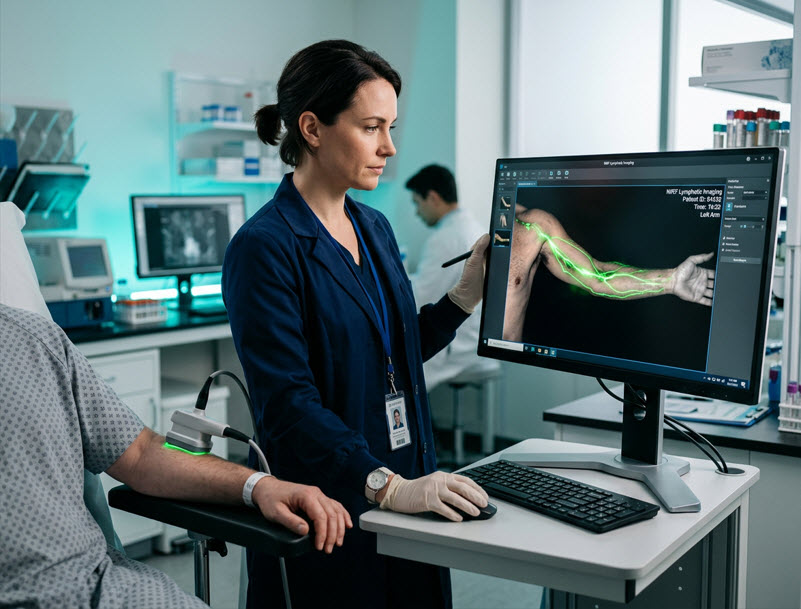
A landmark 2016 study published in Lymphatic Research and Biology used near-infrared fluorescence lymphatic imaging (NIRFLI) to directly observe lymphatic flow in real time.2 The researchers discovered that superficial lymphatic collectors tolerated much higher occlusion pressures than previously believed, with an average occlusion pressure of approximately 86 mm Hg in healthy subjects. (Sage Journals). At first glance, that finding may seem to contradict traditional Foldi-based MLD concepts emphasizing gentleness in applying MLD pressure. In reality, the research actually reinforces many of Foldi’s core principles.
The Foldi Philosophy: Pressure Is Not the Goal
The Foldi method, developed by Michael Földi and Ethel Földi, teaches that successful lymphatic treatment depends on:
- stimulating superficial lymphatic vessels,
- encouraging lymphangion contraction,
- reducing tissue congestion,
- and redirecting fluid toward healthy drainage territories.

The emphasis has always been on precision over force.
Traditional Foldi training warns against aggressive massage because excessive pressure may:
- collapse superficial lymphatics,
- increase capillary filtration,
- irritate tissues,
- or worsen inflammation and fibrosis.
The 2016 NIRFLI study adds important nuance to this understanding.
What the 2016 Study Actually Found
Researchers observed lymph flow in healthy volunteers using fluorescent imaging while gradually increasing pressure with a transparent cuff. They combined this with a specialized MLD approach called the “Fill & Flush Drainage Method” to keep lymphatic vessels actively filled during testing. (Sage Journals)
Their findings included:
- Mean lymphatic occlusion pressure: 86 mm Hg
- No significant differences between age, gender, or side of the body
- Previous studies may have underestimated occlusion pressure due to imaging limitations and insufficient vessel filling during testing (Sage Journals)
Earlier estimates had suggested lymphatic occlusion occurred around 24–40 mm Hg. This new research challenged that assumption. (Sage Journals)
This doesn’t mean deeper or more pressure is better. Find out why in the next blog…
References
1 Foldi, M, Foldi, E. (2006). Foldi’s Textbook of Lymphology (2nd ed.), p. 526. Germany: Urban and Fisher.
2 Belgrado, J.-P., Vandermeeren, L., Vankerckhove, S., Valsamis, J.-B., Malloizel-Delaunay, J., Moraine, J.-J., & Liebens, F. (2016). Near-infrared fluorescence lymphatic imaging to reconsider occlusion pressure of superficial lymphatic collectors in upper extremities of healthy volunteers. Lymphatic Research and Biology, 14(2), 70–77. https://doi.org/10.1089/lrb.2015.0040